
REPAIRS to the M32 Eastville flyover will take six years and cost up to £450 million.
But National Highways, which is responsible for the concrete viaduct, will keep two lanes open in both directions throughout the work, and says roads which cross underneath will also stay open.
The work could be done in quicker were the flyover to shut – but that would leave the busiest route into Bristol, which carries 85,000 vehicles a day, closed for three years.
National Highways, the government body responsible for the motorway network, revealed more details about the project today.
It will involve renewing the drainage system, creating new noise barriers and replacing 130 bearings on top of the concrete columns or piers, extensive repairs to the concrete both on the top and bottom of the bridge deck, replacing parapets, lighting, the central reservation and gantries, resurfacing and re-waterproofing and possibly replacing the edge beams of the 1km flyover.
After funding for the project was confirmed in March, design work has been underway and is due to finish next year, with a contractor set to be appointed in 2028.
Work will get underway in 2029 and is expected to take up to six years, which means finishing in 2035.
‘100%’ commitment to keeping M32 open
Project manager Will Miller said the work could be done in half the time if the motorway were to be closed, but National Highways is committed “100%” to keeping it open in both directions, as there is nowhere else that could cope with the amount of traffic that uses the motorway.
He said: “It’s essential to keep Bristol city centre open for business.”
Muller Road and Stapleton Road, which cross under the motorway at the Junction 2 roundabout under the flyover, will also be kept open – but the motorway entry and exit slip-roads will be closed in turn, for several months each, for work on the edge of the viaduct.
During the works, the central reservation will be removed so the lanes can be moved away from the side where work is taking place at any given time.
The speed limit will be reduced to 30mph to protect contractors at work, before being returned to 40mph after the work is finished.
When slip-roads are closed, motorway traffic is likely to be directed to the next junction, and Mr Miller said National Highways will work with Bristol City Council to alleviate congestion “hotspots” caused by the work.
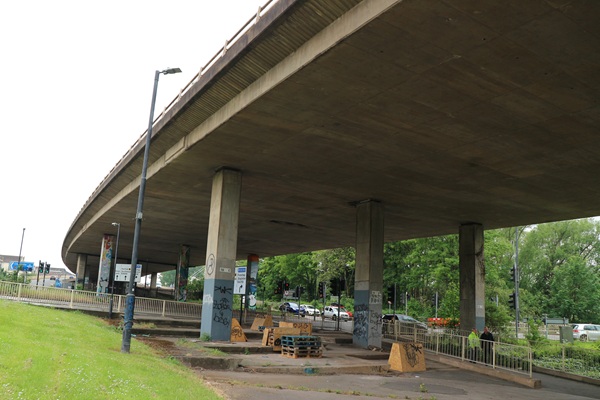
The project is complicated by the location of the flyover, with houses just 10m away from it in some places, a large Tesco supermarket and Ikea superstore also alongside and the River Frome running underneath, including flood management infrastructure for the city.
Engineering team manager Terry Robinson said the viaduct is a post-tension steel-reinforced concrete structure – the same type as the Badminton Road bridge over the M4, which had to be closed in 2023 due to structural failure and is being replaced with a new bridge with steel beams.
The Eastville flyover has not suffered the same problems. The steel cables that compress the concrete to make the bridge stronger, and the structure on the whole, are in good condition.
Doing nothing not an option
But he said if nothing done to the bridge now, within 10 to 20 years problems would start to emerge that could lead to emergency lane closures and repairs, weight restrictions and eventually the viaduct becoming unusable.
The planned six-year refurbishment programme should give the bridge another 40 to 50 years of use.
Trying to demolish it would take months, and would be dangerous for people living in neighbouring homes, because of the sometimes explosive reaction of the steel when it is broken.
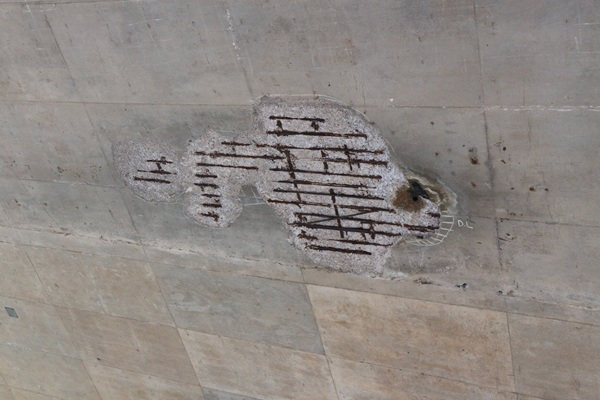
Mr Robinson said the work being done in the design stage includes ultrasound scans of the concrete to examine and assess the condition of internal structure, including the 3,500 steel cables, and working out how to jack the bridge deck up from the concrete pillars to replace the bearings.
He said: “We’re not dealing with just one structure. It may look like one structure, but there’s actually six structures, four retaining walls and five gantries.”
There will be some overnight carriageway closures on the motorway in the autumn for investigation work.
Around the same time public engagement work will be carried out locally to give people living nearby more information about how the works might affect them.
Mr Miller said some of the work will create a “racket” which will be heard by neighbours, which is one reason why it will not be carried out around the clock.
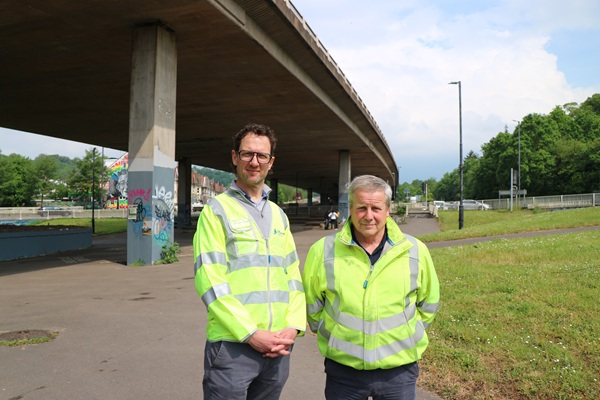
Top picture: Will Miller and Terry Robinson of National Highways at the Eastville flyover.